

Cut Worms

With Transmitter, Max Clarke seems to bring into focus everything he’s been exploring as Cut Worms over the years. The fourth LP, produced by Jeff Tweedy at Wilco’s Loft studio, finds him deepening his craft while opening his songs up to a more collaborative, expansive approach, leaning into the tension between connection and isolation shaped by modern life and the myth of self-reliance. At the same time, the record still carries that familiar Cut Worms warmth, drawing from melodic songwriting traditions while pushing into darker, more textured territory (“Evil Twin,” “Long Weekend,” “Dream”).
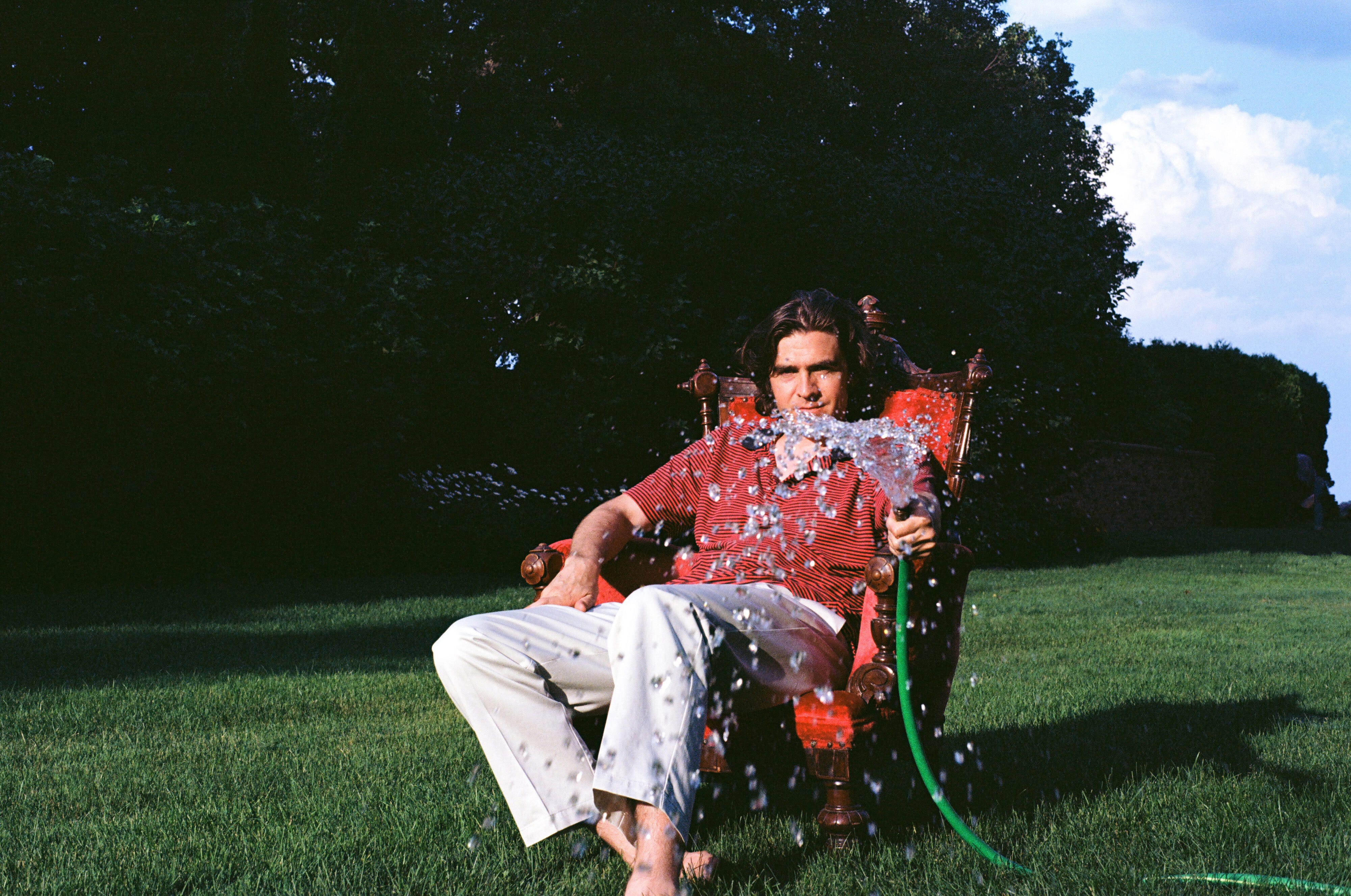
The following interview occurred in February ‘26, weeks before the release of Transmitter.
Hot Sounds: Before we dive into Transmitter, I wanted to ask what it was like growing up in Strongsville, Ohio, and how you first develop an interest in music?
Max Clarke: Growing up there, I kind of liken it to being in the 1950s in some ways. It’s a pretty conservative place, and there wasn’t much happening culturally. Once I got interested in art, music, and film in a more serious way, there really weren’t many peers who were into that stuff. It was mostly varsity sports and strip malls. I got into music from a mix of places, radio mostly, but also my uncles, who were really knowledgeable and introduced me to a lot of older music. There were some great oldies stations back then, too. I remember when they stopped playing ’50s and ’60s music and shifted into the ’70s and ’80s, it felt like they just erased that earlier era entirely.
HS: After moving to cities like Chicago and New York, how have those places shaped your music over the years?
MC: A lot of it was just meeting people with similar interests who could turn me on to new things. Chicago had a really thriving DIY scene when I was there with house shows, basement shows, and warehouse spaces. There was always something going on. By the time I moved to New York around 2015, that kind of scene had mostly disappeared or become more formalized because of costs. But I still met a lot of people who helped me out, especially in terms of sharing my music and getting it heard.
HS: On your previous self-titled record, you recorded with The Lemon Twigs on a couple of tracks, “Don’t Fade Out” and “Living Inside.” What was that experience like collaborating with them?
MC: I mean, they’re great. I’ve known them for years now, I think we first met back in like 2016 or something like that. I’ve played with them and recorded with them on and off a number of times. I feel like on the last record those songs got a good boost from working with them sonically. It was the right type of material for what they bring to the table. In the past, when I tried to record with them, it was usually something I’d already demoed and gotten attached to, and I didn’t really have the language to explain what I wanted to change. There are some recordings we’ve done over the years that haven’t come out yet, which maybe will at some point. But yeah, the long and short of it is they’re great musicians and really talented producers and engineers. It was a lot of fun.
HS: How would you compare Transmitter to past albums like the self-titled one or 2020’s Nobody Lives Here Anymore? What feels most different to you this time around?
MC: To me, it feels like a progression. I think the songs are richer in substance, at least that’s how it feels from my perspective. Production-wise, there’s a cohesiveness that comes from working more closely with a single producer. Nobody Lives Here Anymore had that with Matt Ross-Spang whereas the self-titled record was more patchwork recorded it in different places with different people, and it took more effort to make it feel unified. This one with Jeff [Tweedy], was much more direct. We basically did it in eight days, just knocking out a song a day at The Loft in Chicago, which gave it a natural cohesion.
HS: What surprised you most about collaborating with Jeff and how do think his approach change the way these songs took shape?
MC: What surprised me most was how much he actually wanted to play on the record. I’d never really had that experience before. Usually a producer is more guiding things, but Jeff was very hands-on, playing bass and guitar on almost every song. We’d build up the basic track and then layer parts, and sometimes he’d spend hours figuring out a bass line. I’d just be sitting there saying, “Yeah, that sounds great—do that,” which is a strange position to be in, especially with someone like him. But it worked out really well because he brought ideas I never would have thought of.
HS: When you look back now, what do you feel you were really trying to communicate across this record?
MC: I don’t know if there was one specific message. It feels more like a snapshot of where I was at that moment. Every record is kind of like that, it captures a period of time rather than following a strict linear progression. There are different threads happening simultaneously, even outside this record, so it’s a bit all over the place in that sense.
HS: What made “Worlds Unknown” feel like the right choice to open the album?
MC: That’s one of my favorites. It’s the only co-write on the record, with my drummer Noah [Bond]. He brought in the chord progression and most of the melody, and I added lyrics and another section. It came together really quickly and organically, which made it exciting. The arrangement also builds nicely, it starts more subdued and then picks up, so it just felt like a natural and engaging opener.
HS: The album’s lead cut “Evil Twin” was released back in the summer time. What were you exploring on that song and what do you remember about putting it together?
MC: That one went through a lot of iterations. There’s a home-recorded version that’s longer, with either an extra verse or extended sections. It was one of the first songs I brought into The Loft to record with those guys. Jeff encouraged me to cut it down, which ended up being really helpful. That was one of the biggest things I took from working with him, the “kill your darlings” approach. Just focus on what’s essential and make it as concise as possible. I tend to overwrite sometimes. On earlier records, especially Nobody Lives Here Anymore, I got into writing these six-minute songs. That was interesting in its own way, but it can be a marathon to play live, and looking back, some of them probably could’ve been tightened up. I think stripping it down on “Evil Twin” really made it more effective.
HS: How did “Windows on The World” come about?
MC: I was listening to a lot of Dwight Twilley around that time, he’s a big influence on me. I think I started writing that song while trying to buy a new acoustic guitar. I kept buying and selling different ones, losing money in the process, and one of those guitars ended up being the one I wrote it on. In the studio, the defining part became the volume with the swell guitar layers, which weren’t in the original version. Jeff had all these pedals out, and after he left for the day, the engineer and I stayed behind experimenting. Those layered swells just kind of happened spontaneously, and I don’t think I could recreate them if I tried.
HS: How did “Don’t Look Down” come together?
MC: That one pulls from ideas I’ve had for a long time. There are parts that had been sitting around for maybe 15 years. I finally found a way to fit them together with newer material to complete the song. I was also trying to do that dynamic shift you hear in ABBA’s “SOS,” where it starts off more subdued and then the full arrangement hits you in the chorus. I don’t know if we pulled it off in the same way, but it has that kind of lift, which I really like.
HS: What’s the story behind the closing track “Dream”?
MC: Yeah, I’m always on the lookout for access to a real piano, because it’s so hard to come by living in New York City. When I lived in Chicago, they had this great public library with piano rooms you could rent out for free if you had a library card. You could just go in for an hour at a time, and they had these old uprights that anyone could play. But there isn’t really anything like that here that I’ve found. A friend of mine, Anthony, he’s actually a pastor at a church, let me into his church one day to play the piano when nobody was there. I think that’s where I started, or at least came up with the beginnings of that tune. Then I finished it at home and recorded it there with a metronome. I recorded the piano in a rental room, just an hourly place I found, and then put the arrangement together myself. I guess I sort of produced that song on my own in New York, although it feels a little strange to give myself a full production credit on the record for just one song.
HS: Last winter you had that surreal encounter with Paul McCartney on a Brooklyn sidewalk. What did that moment mean to you personally?
MC: I mean, it kind of meant everything to me. It was shocking, a visceral, physical reaction. I feel like I was somehow able to play it cool a little bit, and we ended up standing there talking to him for almost ten minutes. He’s just such a nice and gracious person. I think he really put us at ease. And I think the fact that none of us immediately grabbed our phones helped, he probably felt like he could actually talk to us. But yeah, just standing there and looking at this person in the flesh, someone I know so much about, it was a really bizarre experience. Everything about it felt surreal.
HS: It seemed like a really warm interaction and he even said the name of your band.
MC: Yeah and I have no way of knowing if he ever looked it up or anything like that, but just the fact that he said it back to me made it feel real in a very strange way that I can’t really describe.
HS: We were discussing this earlier, but thinking back to your earlier records, where does Transmitter sit for you? Does it feel like a new chapter, or more like a natural progression of what you’ve been building?
MC: I don’t know, I feel like it’s a little of both. It feels new, but at the same time it has the same sensibility I’ve always worked with. Every time you make a record, it’s kind of just a moment in time, so I don’t know that it’s all that linear. Between the first session I did in Chicago and the second one, there was another session I did with my drummer Noah down in Memphis with Matt Ross-Spang. We did three songs there that didn’t end up on this record, but I’m sure they’ll be on the next one. So once this record is out, I’m kind of going backward and forward at the same time, finishing what I started with those. It’s all a bit all over the place in that sense.
Transmitter is out now on Jagjaguwar.